Strengthening Ebola Preparedness Through Trusted Networks in Kampala
Strengthening Ebola preparedness through community engagement, stakeholder mobilisation and evidence-informed risk communication across Kampala.
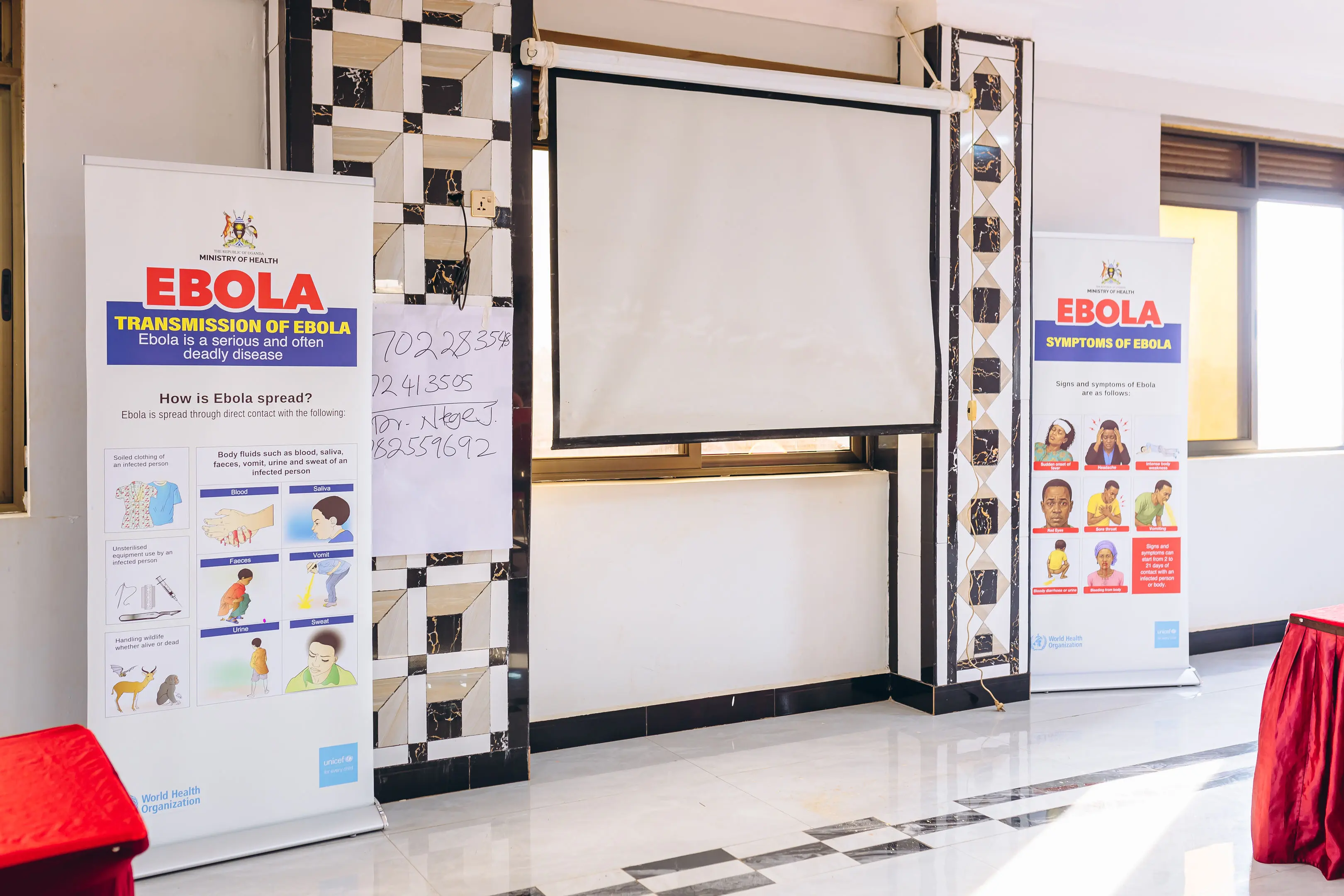
When Uganda declared the end of its 2026 Ebola outbreak, the risk environment remained active. Ongoing transmission in the Democratic Republic of the Congo, combined with Kampala’s dense patterns of cross-border trade, family movement, worship, and health-seeking, required sustained risk communication and community engagement (RCCE). In August 2026, UNICEF contracted Royalway Media mobilise and carry out stakeholder engagement across the Kampala Metropolitan Area to translate this reality into practical preparedness focusing on Congolese communities and other groups.
Royalway Media facilitated the process, bringing together 464 stakeholders from Congolese community and faith networks, service clubs, private health facilities, and the hospitality sector. The activity reached 92.8 percent of its target. Young people aged 18–35 made up 55.6 percent of participants, while women’s participation stood at 42.2 percent—below the 50 percent benchmark and highlighting the need for stronger mobilisation in community and faith spaces.
The engagement was designed as a working communication dialogue rather than a one-way briefing. Technical orientation on signs and symptoms, transmission, prevention, and stakeholder roles was paired with open discussion and systematic social listening. This surfaced consistent behavioural barriers that delay early reporting even when basic knowledge exists.
Fear and distrust featured prominently.
Stakeholders described uncertainty about whom to call and what happens after an alert—to the patient, the family, and, in commercial settings, the business. Isolation was linked to loss of contact and lack of practical support. Nationality-based stigma led some to fear being treated as a risk solely because of Congolese identity. Livelihood concerns were concrete: possible income loss or business closure if a suspected case was reported from a hotel, clinic, or workplace. These fears were reinforced by deeper institutional distrust, including rumours that health workers remove organs.
Knowledge gaps compounded the problem.
Early symptoms such as fever, weakness, and body pain overlap with malaria and other common illnesses, delaying suspicion. A persistent belief that visible bleeding must be present before Ebola can be considered made early cases harder to recognise. Confusion remained around the distinction between incubation, symptom onset, and infectiousness, as well as transmission routes. Political and commercial narratives, together with the framing of Ebola as a “Congolese disease,” further eroded trust and encouraged concealment.
Participants did not position themselves as passive audiences. Faith and community leaders requested approved messages in the languages used by their congregations and networks, simple responses to difficult rumours, and clear alert and feedback contacts. They already hold platforms—worship services, community meetings, and local social structures—that can carry verified information if provided with the right tools.
Women highlighted roles they can play in household communication, safe care, early alerts, and promoting safer, dignified funeral practices, provided they receive practical home-care guidance and respectful mourning alternatives. Youth and peer networks proposed sensitisation, WASH advocacy, rumour reporting, and digital communication, requesting simple peer tools and approved content for platforms such as WhatsApp and TikTok.
Health workers and private facilities identified operational needs: refreshed triage and infection prevention and control capacity, personal protective equipment, surveillance and referral standard operating procedures, and verified alert contacts. Hospitality and business operators asked for one-page job aids, clear steps for suspected illness, confidentiality assurances, and explicit guidance on when business closure might apply, so that fear of economic loss does not suppress reporting.
The process generated concrete commitments and priority actions manageable by the RCCE pillar. These include approving a single multilingual package of Ebola and rumour-response messages; confirming one clear alert and referral pathway with verified contacts; developing practical tools for faith, health, hospitality, and business actors; establishing a feedback and stakeholder-action tracker; strengthening private-facility readiness; and activating more structured engagement with women and youth networks.
The decisions requested from the RCCE coordination structure are correspondingly clear: confirm technical authority and sign-off for messages; validate the full alert-to-referral-to-feedback sequence; assign responsible leads and timeframes; and agree ongoing two-way linkage with the networks that participated.
In high-mobility urban settings, risk communication succeeds or fails on whether people understand the practical consequences of reporting and whether they trust the institutions and messengers involved. The Kampala engagement, facilitated by Royalway Media under Ministry of Health technical leadership and with UNICEF support, demonstrates how participatory methods and social listening can surface those conditions in real time and convert them into roles, tools, and follow-up mechanisms.
By combining reach across influential networks with documented barriers, knowledge gaps, and stakeholder-owned commitments, the activity supplies the evidence base and relational foundations that sustained epidemic preparedness requires. For organisations seeking partners capable of designing and delivering inclusive, evidence-informed social and behaviour change work that links community insight directly to operational response speak to Royalway Media for structure behavioral Communication intervention.
Email: sales@royalwaymedia.com